

Executive Summary
SchedAI turned a feasible timetable into a stronger room-fit decision.
A university academic planning team needed to build a fall class timetable before releasing it to students and faculty. The case included 21 courses, 30 class meetings, 12 professors, 15 timeslots, 5 baseline rooms, 2 meeting patterns, 6 course relationships, and 10 section groups.
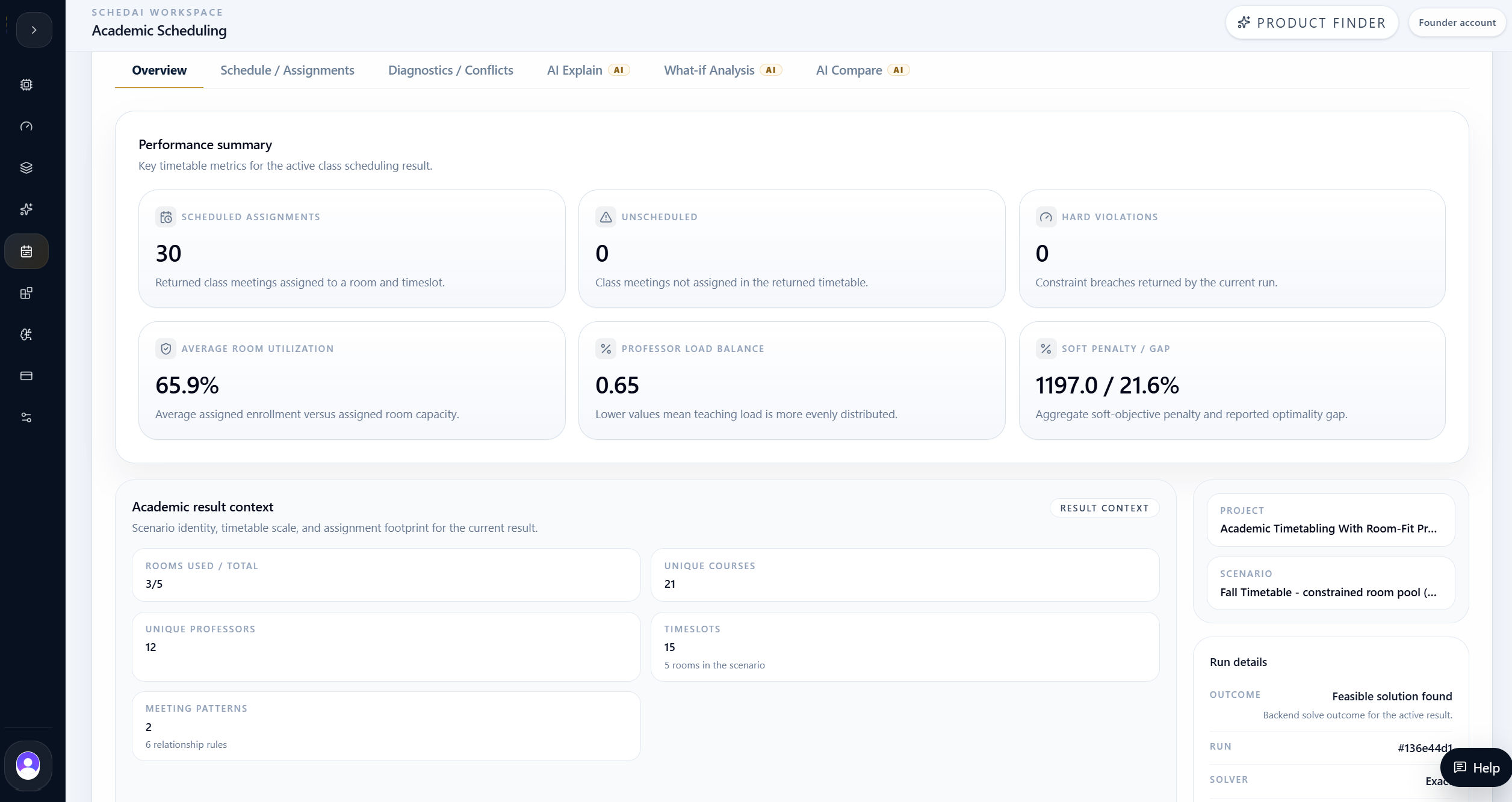
SchedAI Academic generated a feasible baseline with no hard violations, but the result was not a finished planning answer. The baseline carried a 1197.0 soft penalty, a 21.6% solver gap, and only 65.9% average room utilization because the constrained room pool forced smaller meetings into oversized spaces and reduced schedule-quality flexibility.
AI Explain made the weakness clear: the timetable was feasible, but room-fit pressure, lecture-lab ordering, cohort no-overlap rules, professor availability, and room blackouts were driving quality loss. The team tested one practical What-if branch: add SEMINAR_36, a 36-seat projector seminar room, while keeping the same courses, professors, timeslots, relationships, and section groups.
The branch improved the timetable materially. Soft penalty dropped from 1197.0 to 505.0, the gap closed from 21.6% to 0.00%, average room utilization increased from 65.9% to 83.7%, and the result stayed feasible with 0 hard violations.
Soft penalty
1197.0 to 505.0
Gap
21.6% to 0.00%
Room utilization
65.9% to 83.7%
Core capabilities exercised
- Class timetable optimization across courses, professors, rooms, timeslots, and meeting patterns.
- Professor availability, allowed slots, instructional assignments, and professor load-limit review.
- Room capacity, features, resources, building, room type, and blackout constraints.
- Lecture-lab ordering, student cohort no-overlap rules, and section-group coordination.
- Hard feasibility metrics plus soft-quality KPIs for penalty, solver gap, utilization, and load balance.
- AI Explain to interpret a feasible but pressured timetable before changing the scenario.
- What-if Analysis and AI Compare to test a targeted facility change against the saved baseline.
Academic Context
A class timetable must balance feasibility, room fit, and academic quality.
Academic timetabling is not just a room-booking exercise. A weekly plan has to coordinate course demand, professor availability, room capacity, specialized room features, meeting patterns, student-group conflicts, and course relationships before students ever see the schedule.
In this case, the planning team was working with a mixed teaching environment: lecture meetings, lab meetings, smaller seminar-style meetings, professor availability limits, and shared student cohorts that could not be scheduled into overlapping classes.
The baseline room pool was deliberately constrained. The institution had enough rooms to build a feasible timetable, but the mix of larger lecture rooms and lab spaces created pressure when smaller seminar-sized meetings needed a better fit.
That distinction matters for academic operations. A timetable can satisfy every hard constraint and still create inefficient room usage, awkward capacity matches, and quality penalties that make the schedule harder to defend when faculty or facilities teams review it.
The institution needed a workflow that could do more than produce any feasible timetable. The planner needed to understand whether the timetable was high quality, why quality was being lost, and whether a small operational change could improve the result before facilities or academic commitments changed.
Scheduling Challenge
The baseline had no conflicts, but it still carried real room-fit pressure.
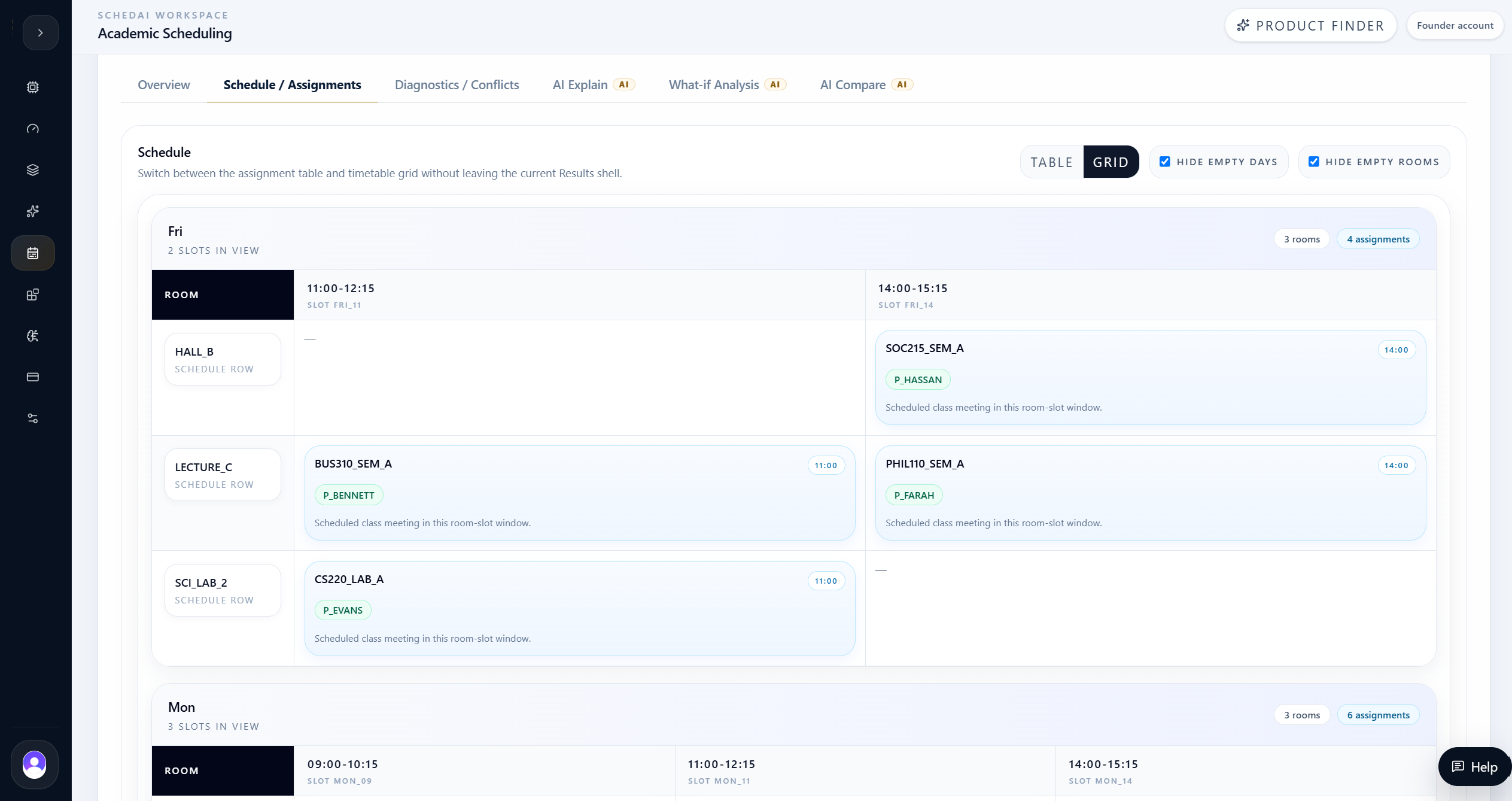
The baseline problem was intentionally not perfect. It was feasible, and every class meeting was scheduled, but the room pool was too coarse for the demand mix.
With only five baseline rooms, the optimizer had enough capacity to place all 30 meetings without hard conflicts, but not enough right-sized flexibility to keep small seminars out of oversized lecture rooms. That created a high soft penalty and a 21.6% gap even though the timetable looked acceptable at first glance.
This is the kind of case where AI-assisted review matters. A planner looking only at scheduled assignments and hard violations might accept the baseline. SchedAI had to show the deeper planning pressure and help the team test a targeted fix.
Constraints considered
- Room capacity and room-fit quality, not just room availability.
- Room features and resources such as projector, whiteboard, and lab capability.
- Professor availability and assignment feasibility.
- Course meeting patterns across the week.
- Lecture-lab ordering relationships between related meetings.
- Student cohort and section-group no-overlap rules.
- Room blackouts that reduce usable slot flexibility.
Method: Input Setup
The team loaded a full academic timetabling bundle.
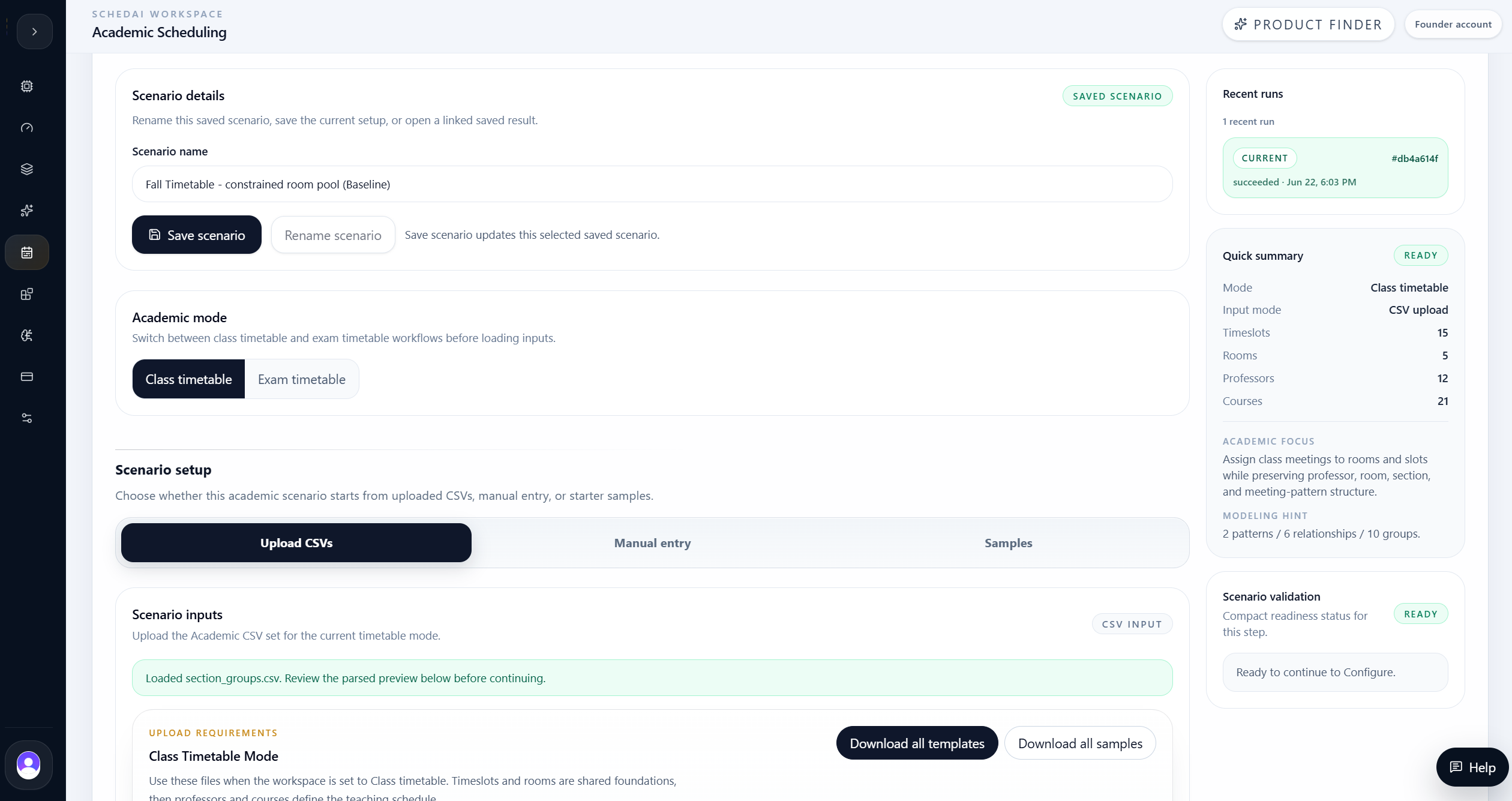
The team loaded a complete academic scheduling bundle into SchedAI. The uploaded files represented the whole class timetabling case: courses, professors, rooms, timeslots, meeting patterns, course relationships, and section groups.
The setup was large enough to show a real optimization workflow without being a toy example. It included 21 courses and 30 class meetings across 12 professors and 15 timeslots, with a constrained five-room baseline pool.
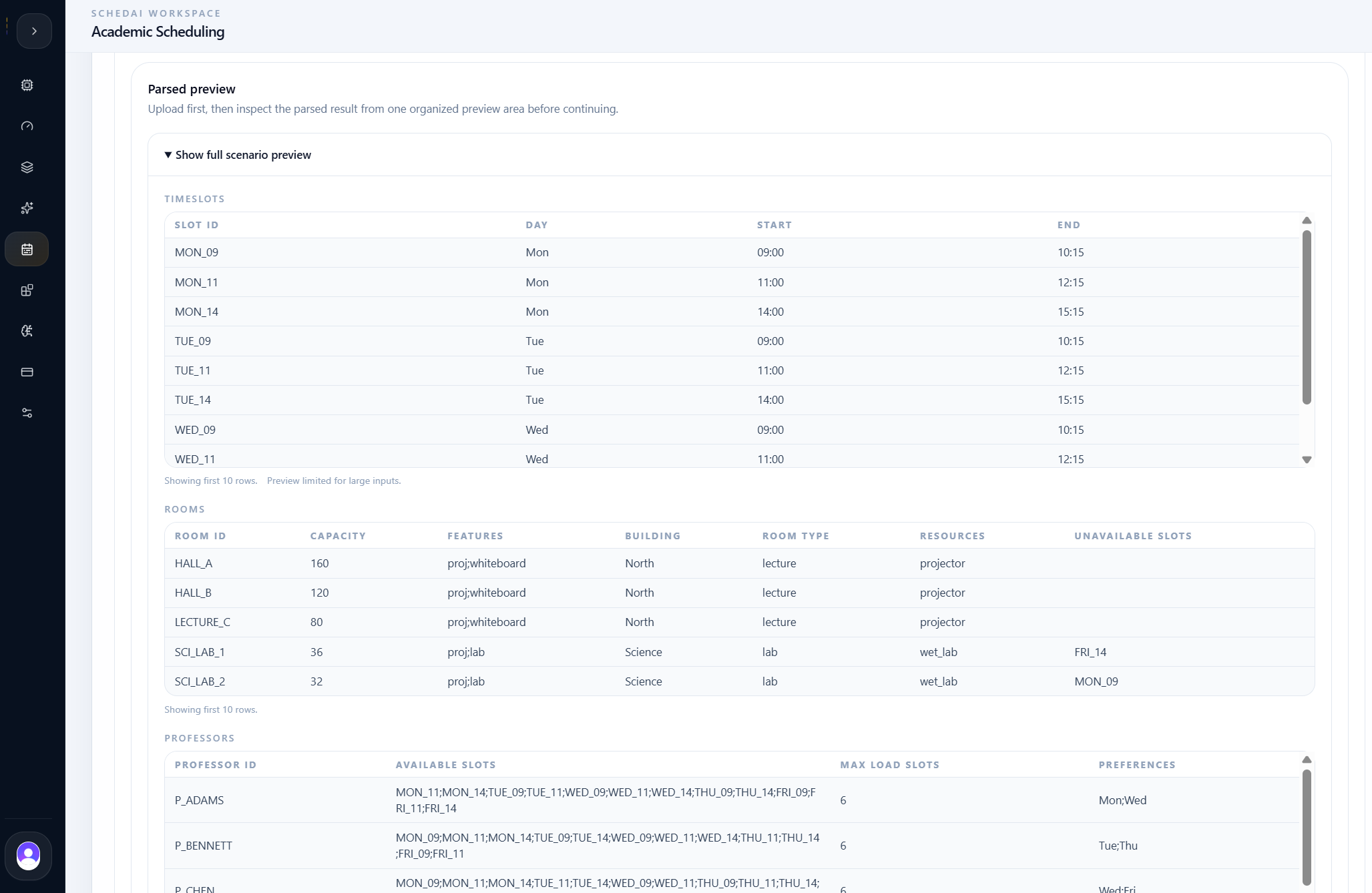
The parsed preview helped confirm that the optimizer was solving the intended university planning problem before any schedule was generated.
Input setup included
- 21 course records with meeting demand and instructor assignments.
- 30 class meetings generated from the course and pattern structure.
- 12 professor records with availability and assignment limits.
- 15 timeslots across the planning week.
- 5 baseline rooms with capacity, type, feature, resource, and blackout information.
- 6 course relationship rules.
- 10 section groups for student-cohort coordination.
Method: Configuration
The solver setup preserved academic constraints and quality signals.
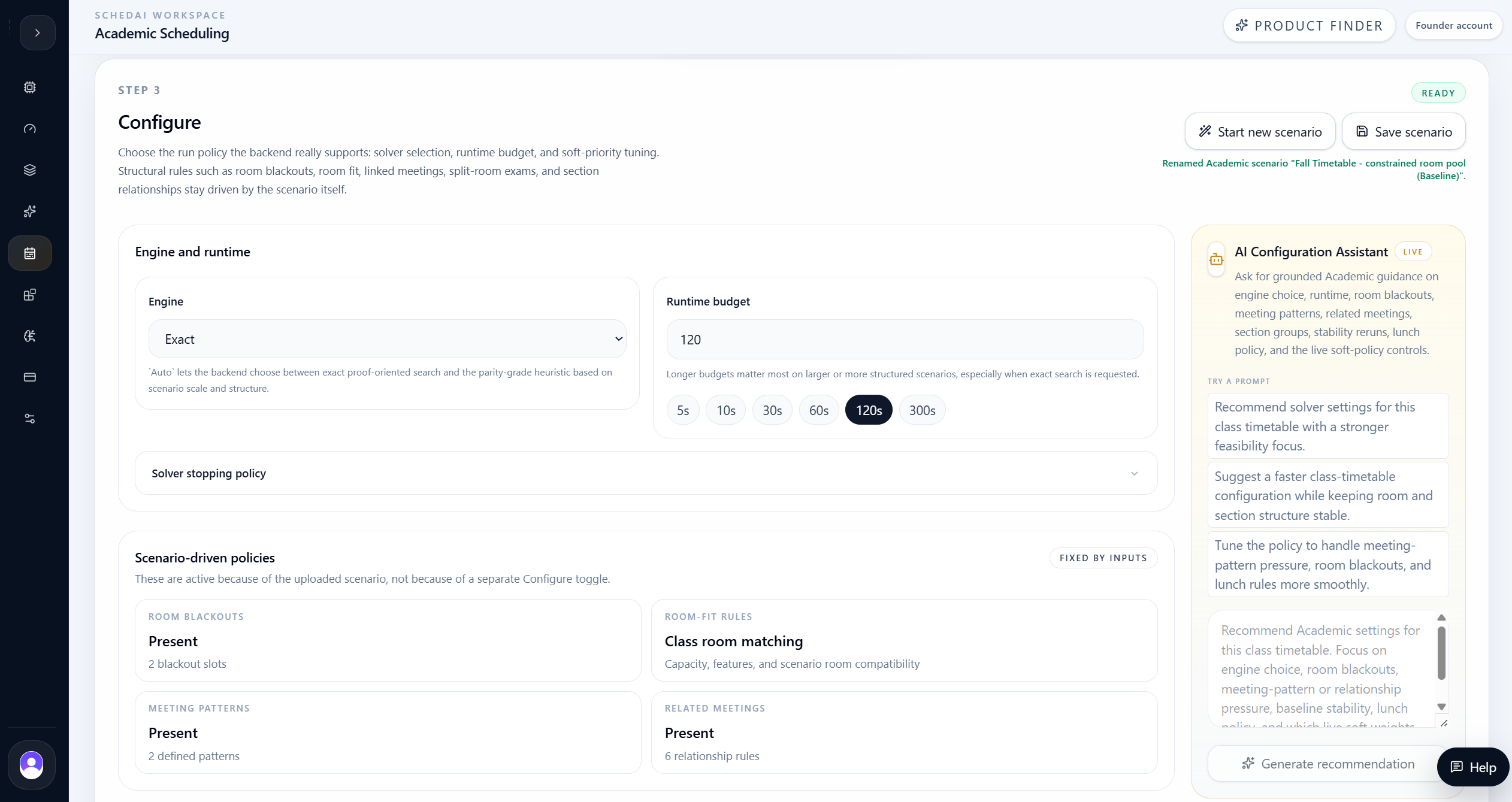
The Academic run used class-timetable mode and the Exact solver path. The validated baseline was run with a 60-second time limit and a 5.00% quality tolerance shown in the workspace.
The configuration preserved the important academic constraints instead of simplifying the problem into a generic calendar. Room capacity, room features, room blackouts, professor availability, meeting completeness, related meetings, and section-group conflicts stayed in the model.
That setup gave the team a useful baseline: the solver could find a feasible timetable, but the result still exposed quality loss through soft penalty, gap, average room utilization, and professor load balance.
Configuration choices
- Class timetable mode selected for course, room, professor, and timeslot assignment.
- Exact solver selected for a constrained academic scheduling run.
- 60-second runtime used for the validated app baseline.
- 5.00% quality tolerance visible in the run details.
- Soft-quality metrics kept visible so the baseline could show pressure.
Method: Run Optimization
SchedAI translated the academic bundle into a constrained timetabling model.
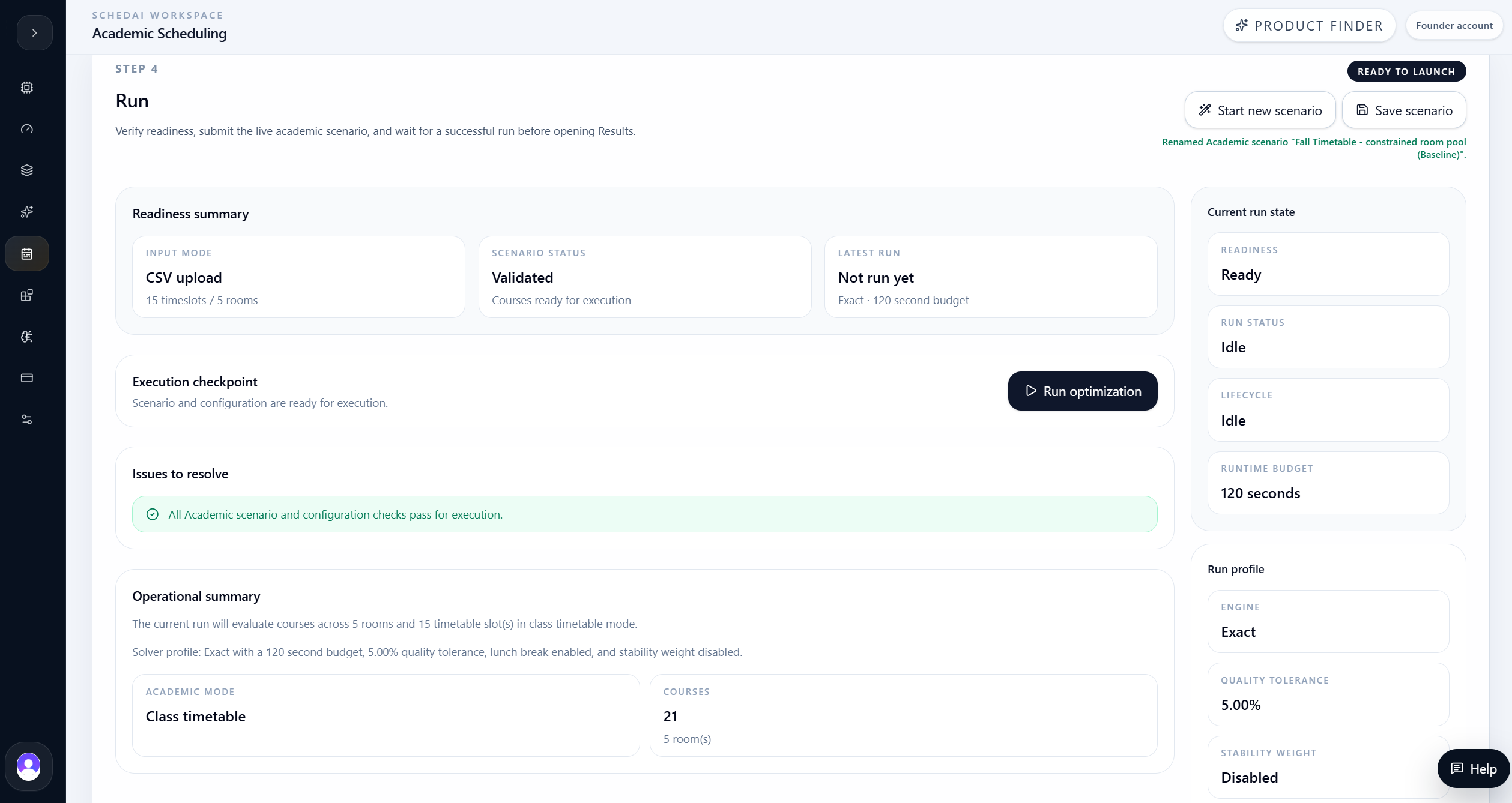
SchedAI translated the validated bundle and configuration into a constrained academic timetabling model.
The model considered assignment feasibility, room eligibility, professor availability, cohort conflicts, meeting patterns, course relationships, room blackouts, and soft-quality objectives.
This step turned the CSV bundle into an auditable schedule result. The planner could inspect KPIs, assignments, schedule layout, diagnostics, AI Explain, What-if Analysis, and AI Compare before choosing an academic planning decision.
Optimization model considered
- Every meeting must be assigned to a valid timeslot and room.
- No professor can teach overlapping meetings.
- No room can host overlapping meetings.
- Room capacity, room type, features, resources, and blackouts affect eligibility.
- Professor availability and allowed slots restrict feasible placements.
- Course relationships and section groups reduce conflict-free slot options.
- Soft objectives evaluate room fit, quality penalty, utilization, and solver gap.
Baseline Evidence
The baseline was feasible, but not decision-ready.
| Baseline KPI | Value |
|---|---|
| Scheduled assignments | 30 |
| Unscheduled | 0 |
| Hard violations | 0 |
| Soft penalty | 1197.0 |
| Gap | 21.6% |
| Average room utilization | 65.9% |
| Professor load balance | 0.65 |
| Rooms used | 3 / 5 |
The baseline result found a feasible timetable. All 30 assignments were scheduled, no meetings were left unscheduled, and hard violations were 0.
That is useful, but it is not the whole story. The same result showed a 1197.0 soft penalty and a 21.6% gap. Average room utilization was only 65.9%, and the baseline used 3 of the 5 available rooms.
The baseline therefore became a strong use case: it was operationally feasible, but it left a visible quality gap that a planner could investigate instead of blindly accepting the first feasible timetable.
AI Explain
AI Explain connected the baseline penalty to room-fit pressure.
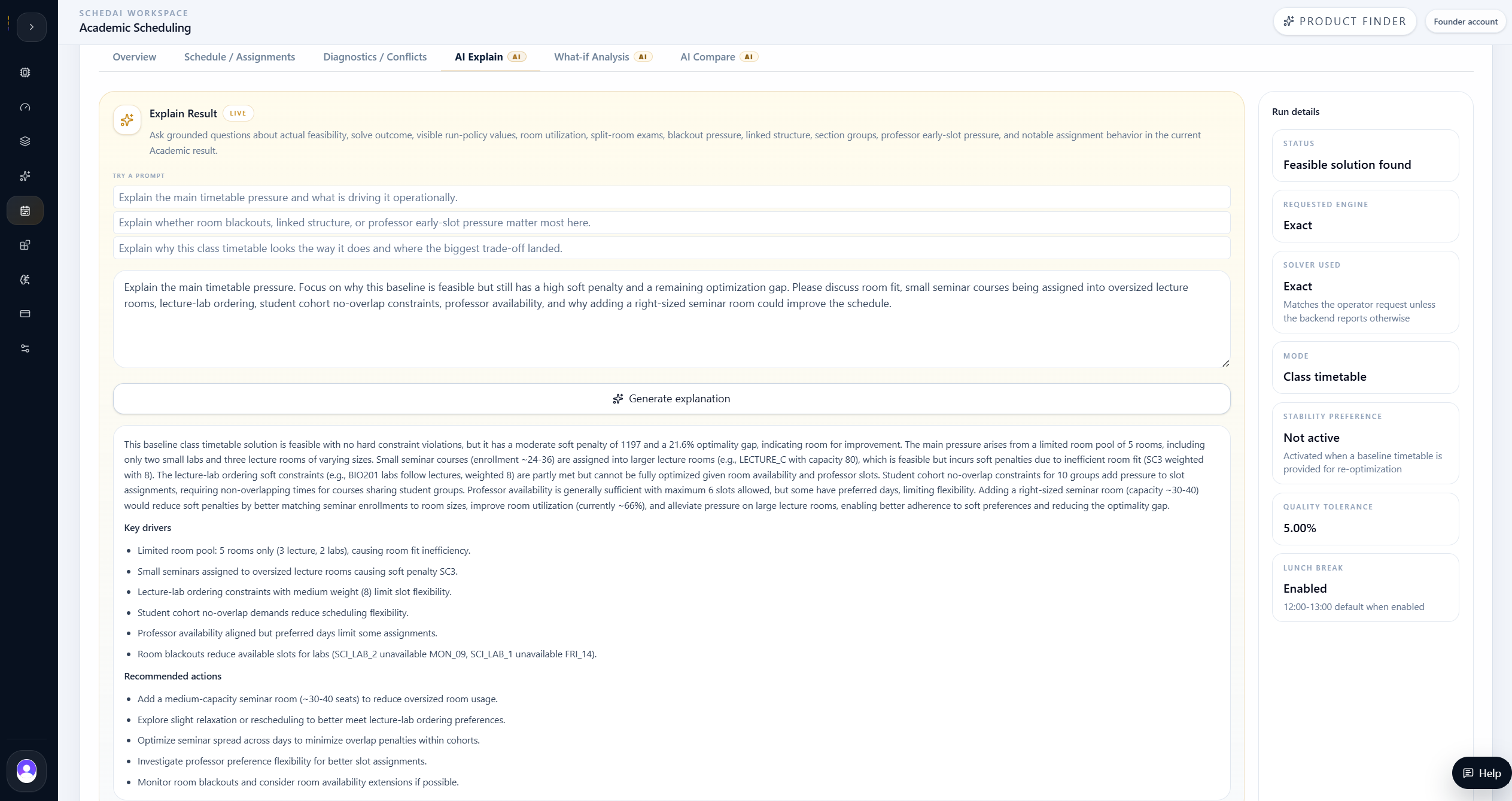
AI Explain converted the baseline metrics into a planning diagnosis. It confirmed that the timetable was feasible with no hard violations, but highlighted that the soft penalty and gap were meaningful signals.
The explanation connected the penalty to room-fit pressure. Smaller meetings were being placed into oversized lecture rooms because the room pool had large lecture spaces and labs, but no right-sized seminar room for 24-36 student meetings.
AI Explain also called out the compounding constraints: lecture-lab ordering rules, cohort no-overlap requirements, professor availability, and room blackouts such as lab unavailability during specific Monday and Friday slots.
That made the next What-if test precise. Instead of adding random capacity or relaxing academic rules, the planner could test whether one appropriately sized seminar room would reduce quality loss while preserving the full timetable structure.
What-if Analysis
The team tested one targeted room-capacity change.
What the branch changed
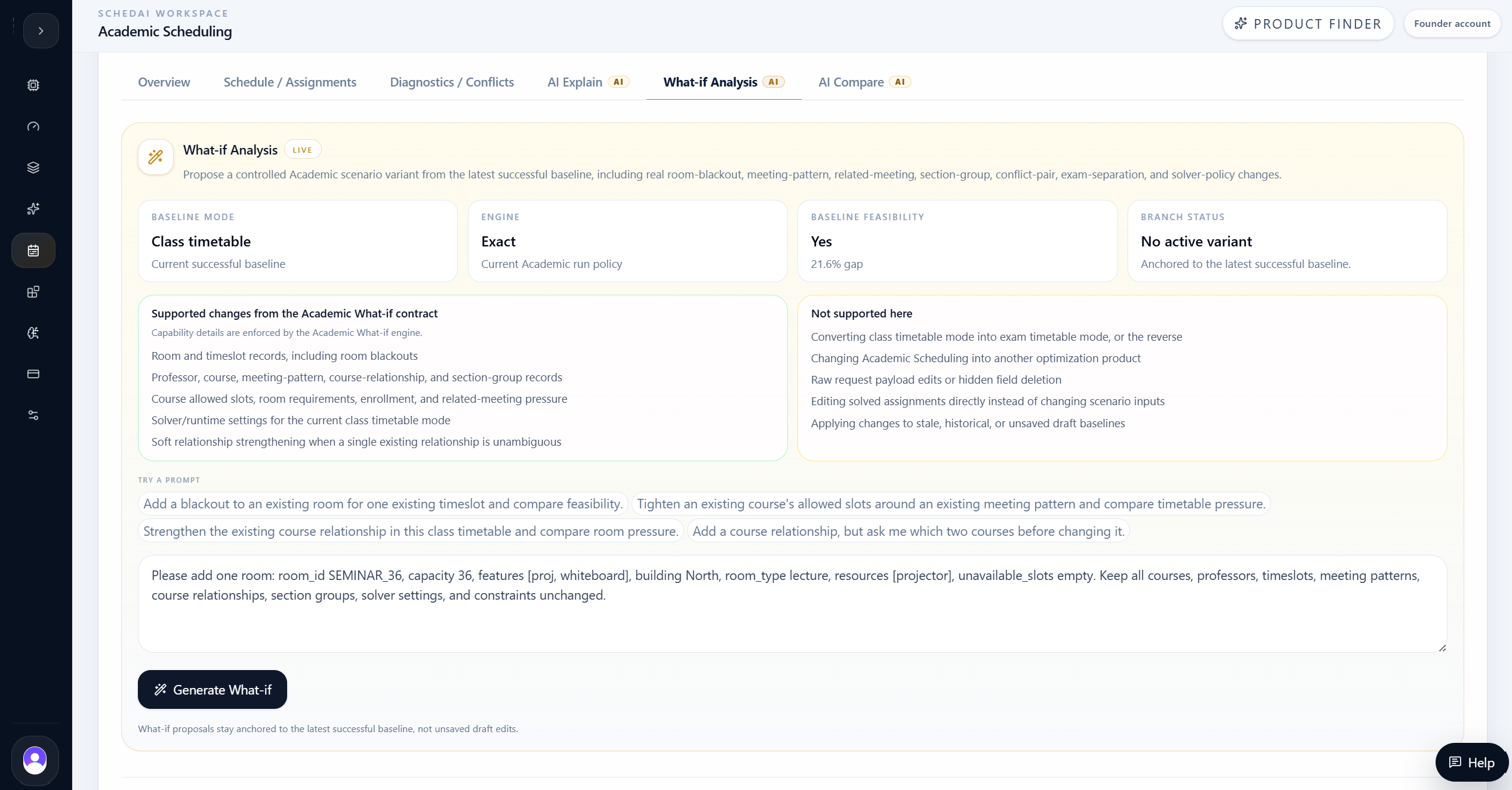
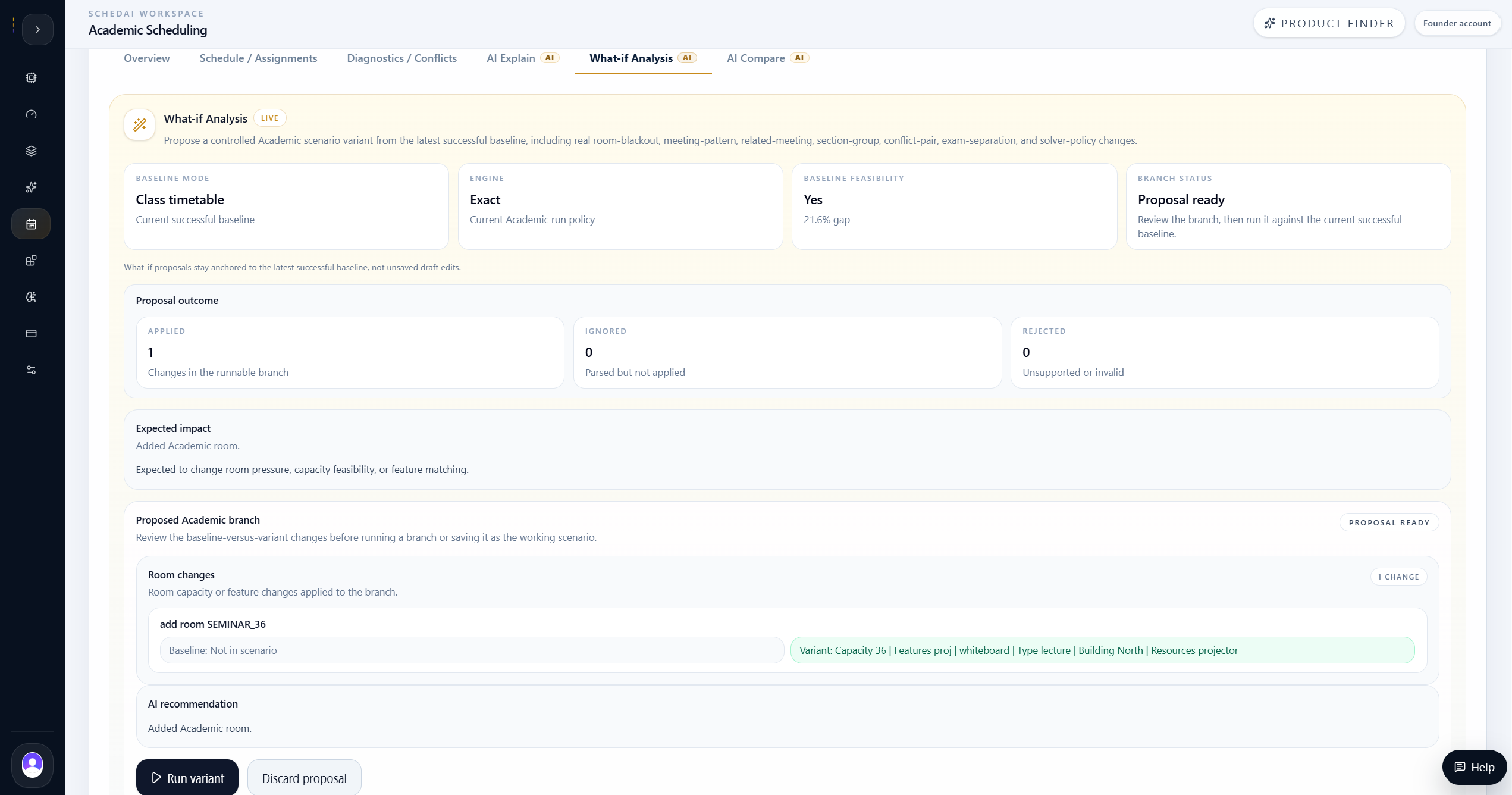
- Added room SEMINAR_36.
- Capacity set to 36 seats.
- Features set to projector and whiteboard.
- Building set to North.
- Room type kept compatible with lecture or seminar-style meetings.
- No unavailable slots added to the new room.
- Courses, professors, timeslots, relationships, section groups, and solver policy stayed unchanged.
The What-if branch added one room, SEMINAR_36, and left the academic demand unchanged.
That made the scenario clean. The branch did not add courses, remove relationships, change professors, or relax section-group constraints. It tested one facility decision: whether adding a 36-seat seminar room with projector and whiteboard support would improve the existing fall timetable.
The proposal review made the mutation visible before the optimizer ran, so the planner could confirm that the branch changed only the intended room resource.
Add-room branch result
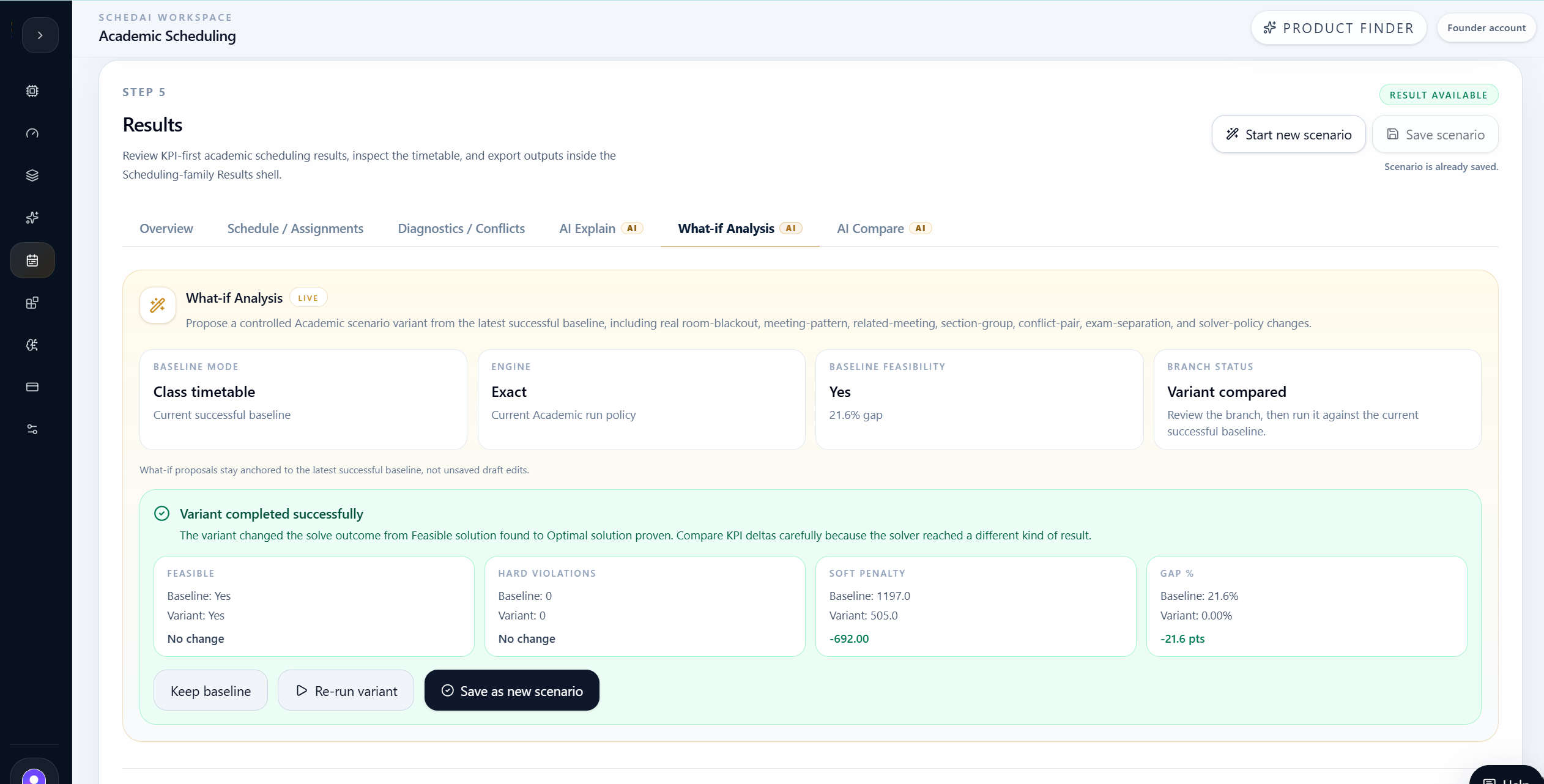
The add-room branch completed successfully and changed the solve outcome from a feasible solution to an optimal solution proven.
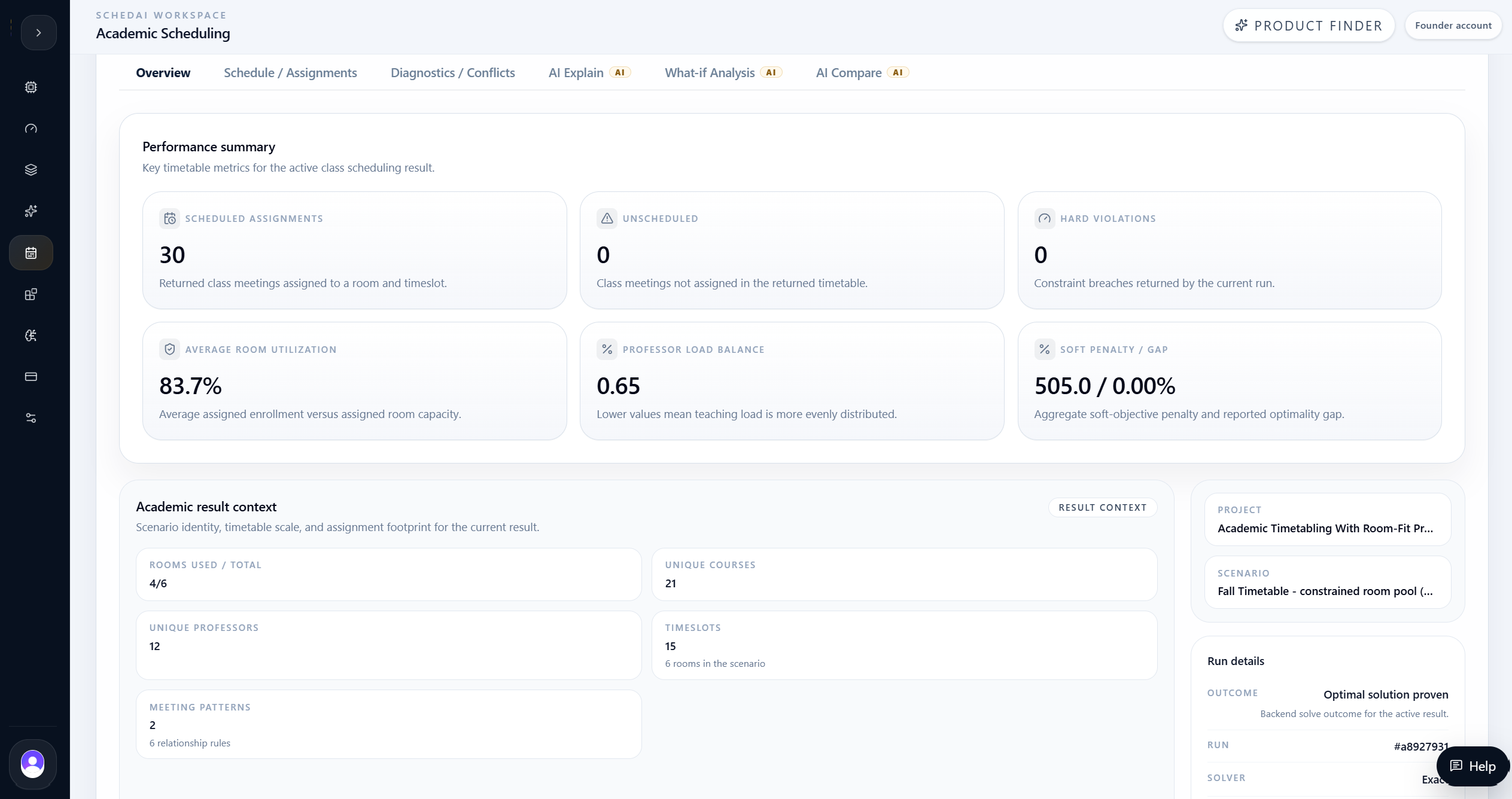
The improvement was not cosmetic. Soft penalty dropped by 692 points, and the gap closed by 21.6 percentage points. Average room utilization increased by 17.8 percentage points, from 65.9% to 83.7%.
Just as important, the branch did not create new feasibility problems. Hard violations stayed at 0, all 30 assignments remained scheduled, and professor load balance stayed at 0.65.
| Metric | Baseline | Add-room branch |
|---|---|---|
| Hard violations | 0 | 0 |
| Soft penalty | 1197.0 | 505.0 |
| Gap | 21.6% | 0.00% |
| Average room utilization | 65.9% | 83.7% |
| Professor load balance | 0.65 | 0.65 |
| Rooms used | 3 / 5 | 4 / 6 |
AI Compare
AI Compare confirmed the variant was materially better.
After saving the add-room scenario, the team used AI Compare to evaluate the baseline against the improved timetable.
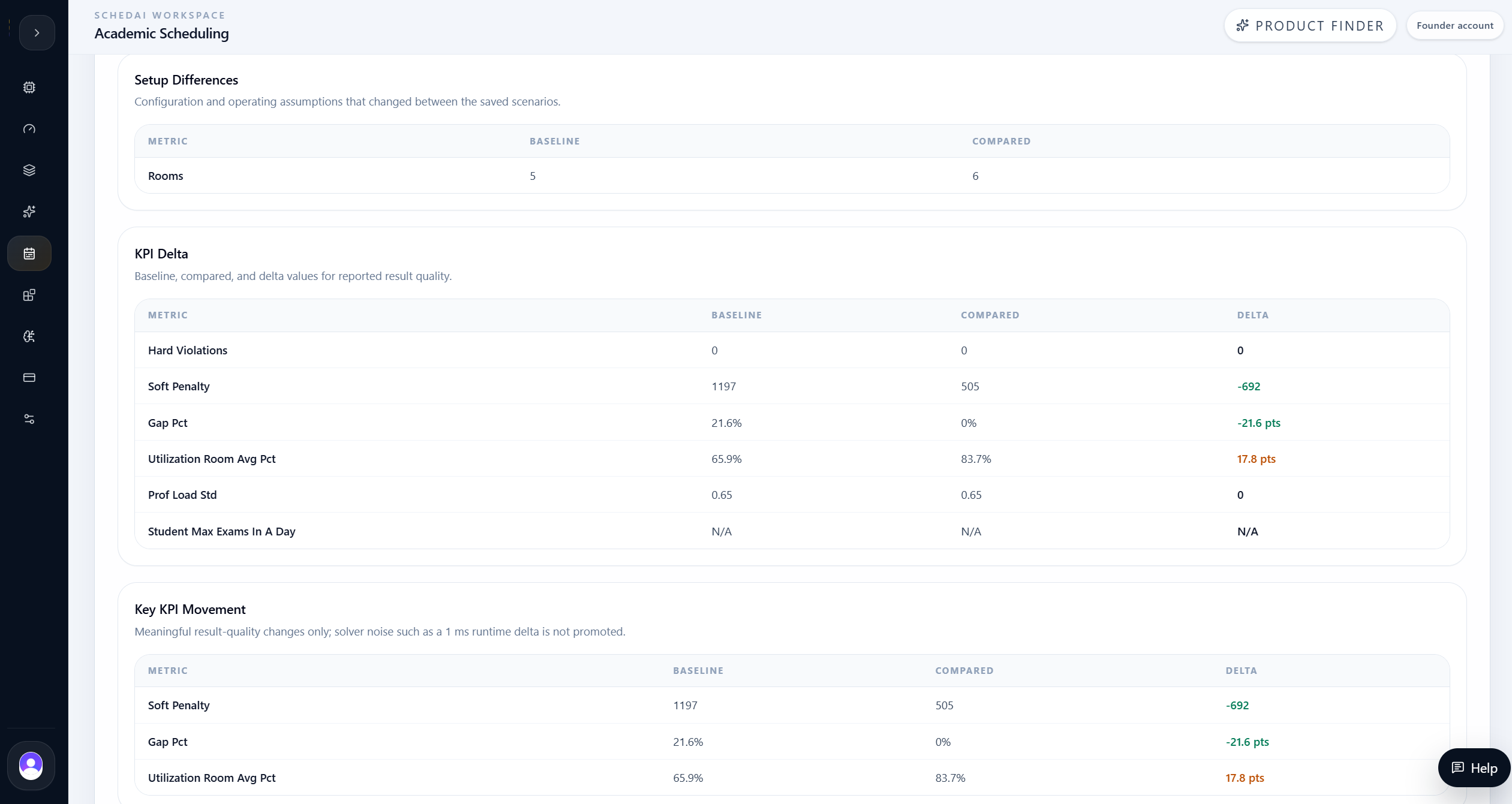
The comparison kept the setup difference clear: the variant added one room to the room pool. Assignments stayed at 30, professors stayed at 12, and the academic demand did not change.
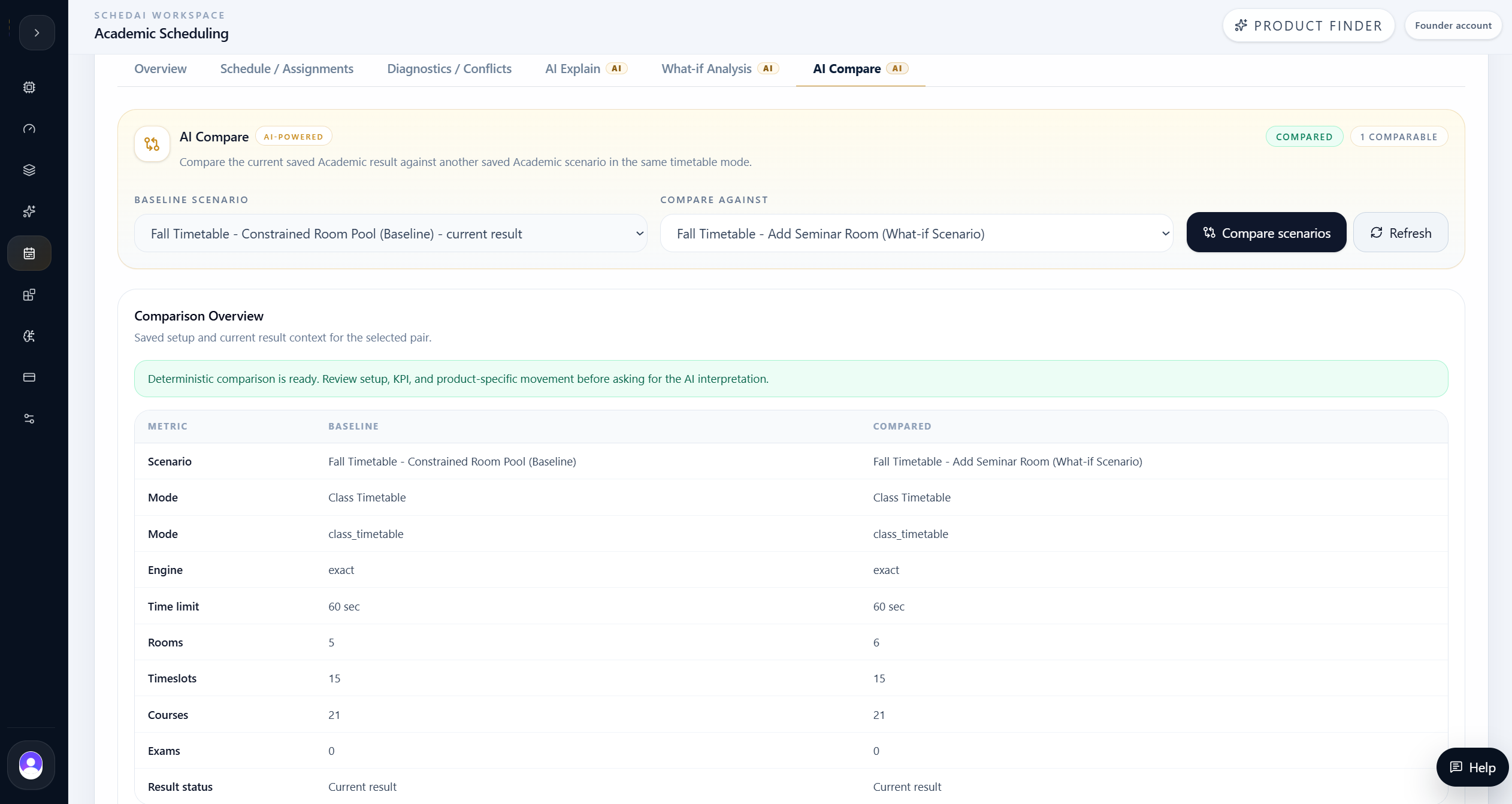
The KPI delta table confirmed why the branch mattered. Soft penalty moved from 1197.0 to 505.0, gap moved from 21.6% to 0.00%, average room utilization moved from 65.9% to 83.7%, and hard violations stayed at 0.
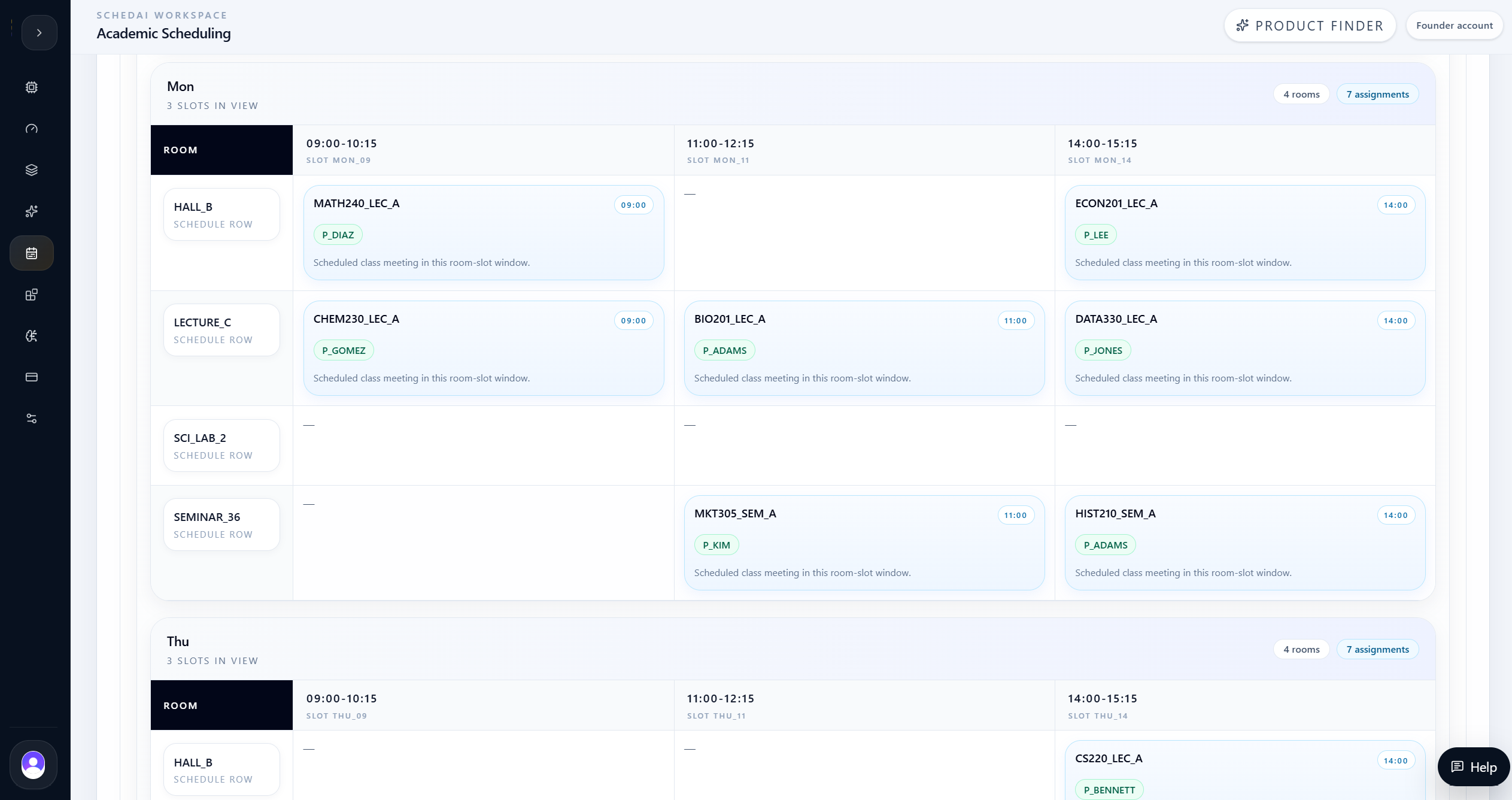
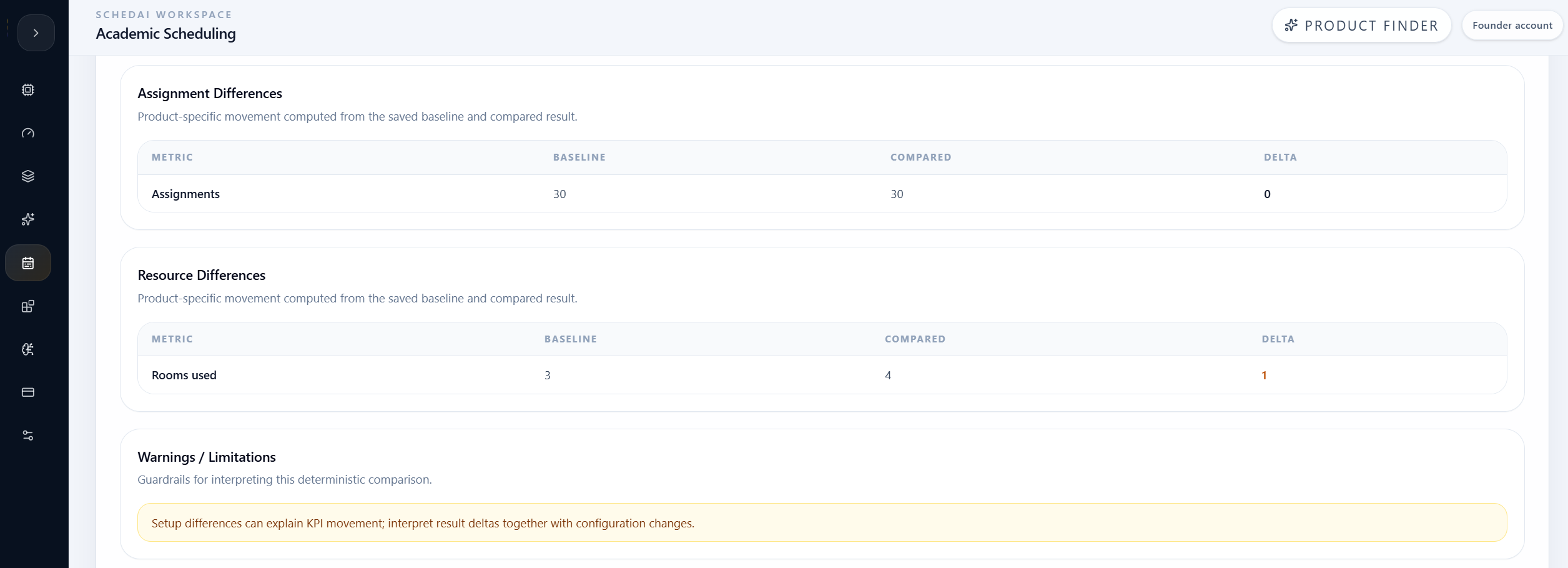
The resource comparison showed the operational trade-off. The plan used one more room, moving from 3 used rooms to 4, because the new right-sized seminar room gave the optimizer a better placement option for smaller meetings.
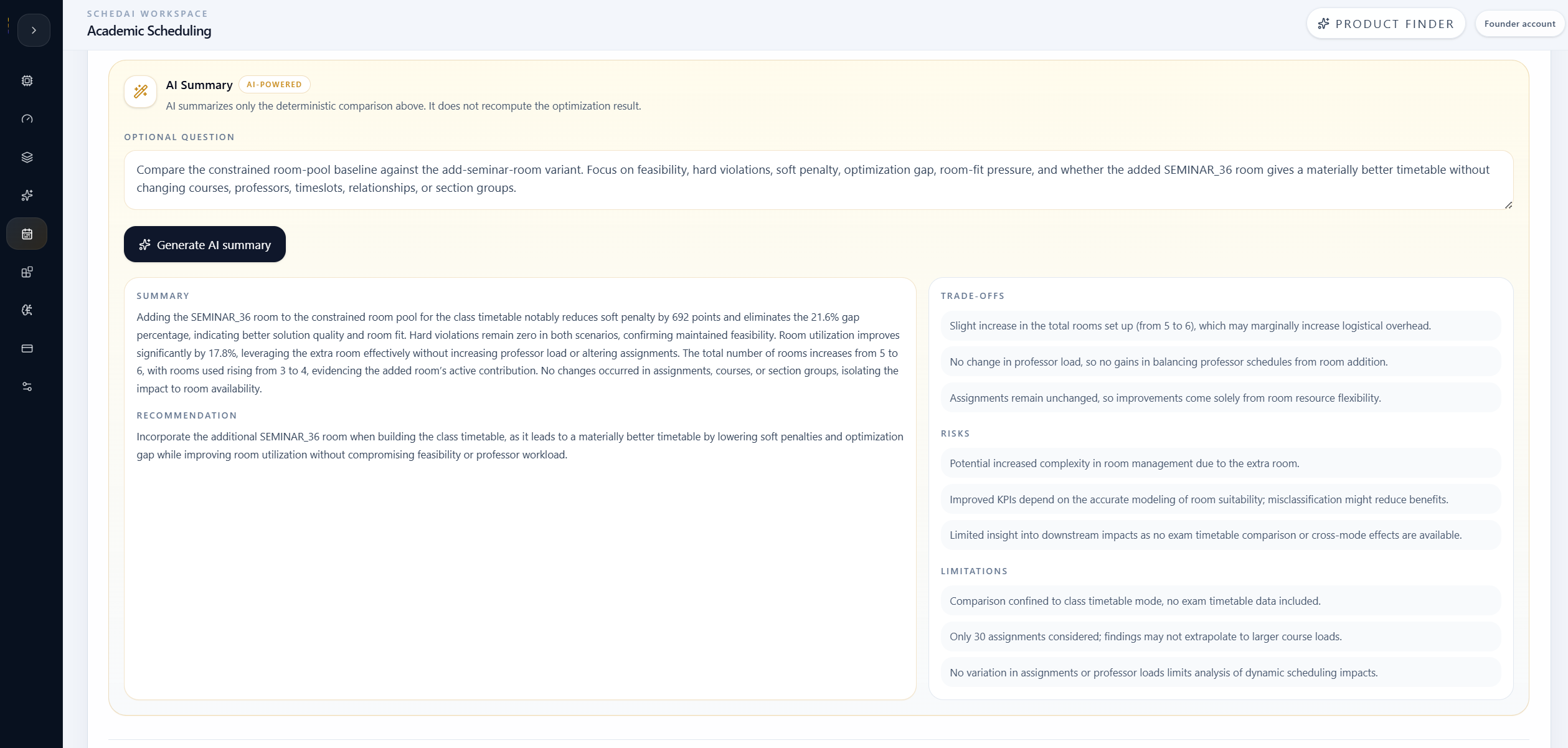
The AI Summary framed the decision in planner language: the variant improves timetable quality and room utilization without changing assignment count or professor load, but it depends on the institution actually having access to a suitable seminar room.
Soft penalty
Baseline: 1197.0
Variant: 505.0
Gap
Baseline: 21.6%
Variant: 0.00%
Room utilization
Baseline: 65.9%
Variant: 83.7%
| Metric | Baseline | Add-room branch | Result |
|---|---|---|---|
| Soft penalty | 1197.0 | 505.0 | -692.0 |
| Gap | 21.6% | 0.00% | -21.6 pts |
| Average room utilization | 65.9% | 83.7% | +17.8 pts |
| Hard violations | 0 | 0 | No change |
| Scheduled assignments | 30 | 30 | No change |
| Professor load balance | 0.65 | 0.65 | No change |
| Rooms used | 3 | 4 | +1 room |
Planning Decision
The team selected the add-seminar-room variant for review.
The team selected the add-seminar-room variant as the stronger timetable to review.
The decision was evidence-based. The baseline was feasible, but it carried room-fit pressure. The variant added one targeted room resource and improved the timetable quality without changing demand, relaxing academic constraints, or shifting professor workload.
The final recommendation was not to add arbitrary capacity. It was to add or reserve the right kind of space: a 36-seat seminar room with the features needed by the smaller meetings.
For academic planners, that is the practical value of SchedAI Academic Scheduling: it can expose a feasible-but-pressured baseline, explain the cause, test a controlled facility change, and compare the result before the timetable is published.
Final takeaway
The baseline scheduled every class, but it still wasted room-fit quality. The add-room branch showed that one targeted seminar room could turn the same academic demand into a stronger timetable.
SchedAI did not only build the timetable. It explained the weakness, tested the planning option, and gave the team evidence for a facilities decision.
Feasible timetables can still hide quality problems.
AI Explain turned penalty and gap metrics into an understandable room-fit diagnosis.
What-if Analysis tested one realistic facilities decision without changing academic demand.
AI Compare showed the exact KPI movement and the trade-off of using one more room.